✦
When insight is not enough
You may already understand the pattern intellectually, yet the emotional response still arrives before choice does.
A premium, structured hypnotherapy session centred on the SORISI Framework — Stabilise, Observe, Reframe, Imagine, Suggest and Integrate. Designed for clients who want more than relaxation: they want insight, emotional steadiness and a clear movement towards change.
Integrative Cognitive–Mindful Hypnotherapy is built around a simple premise: lasting inner change is more likely when the nervous system feels safe, the mind can observe itself clearly, and new suggestions are linked to meaning, imagery and lived behaviour.

This page is written for the person who is tired of fighting the same internal loop: stress, fear, avoidance, self-doubt, emotional eating, smoking triggers, inner criticism, or the quiet sense that life is being lived from an old script.
You may already understand the pattern intellectually, yet the emotional response still arrives before choice does.
The work begins with stabilisation because change is easier when the inner system is not bracing against itself.
The session is not only reflective. It is designed to help you carry a new response into ordinary daily moments.
SORISI gives the session architecture. It keeps the work calm, intentional and grounded, while allowing enough depth for the subconscious mind to respond creatively.
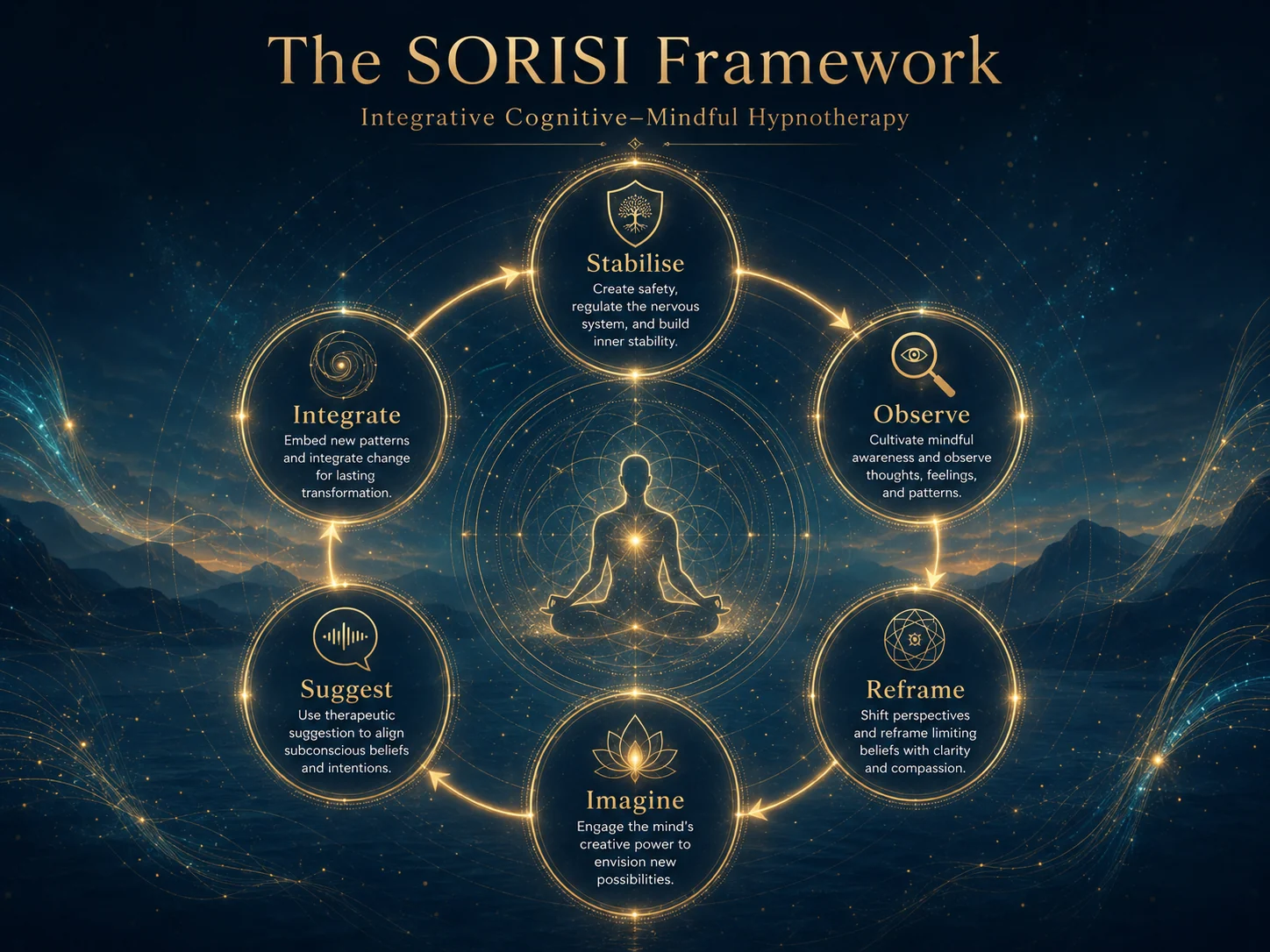
Create enough inner safety for the mind and body to work together rather than resist.
Notice thoughts, feelings, sensations, triggers and repeating patterns with mindful distance.
Shift rigid meanings and limiting beliefs into perspectives that are more spacious and useful.
Use therapeutic imagery to let the mind rehearse possibility, resilience and a different response.
Introduce carefully chosen suggestions aligned with your goal, values and emotional readiness.
Translate session insight into small, realistic actions that can continue after the appointment.
The work is shaped around your goal. The exact rhythm may vary, but the process usually follows this structure.
You describe what you want to change, what you have already tried, and how the pattern appears in real life.
Your questionnaire and conversation help identify whether hypnotherapy is appropriate, or whether medical or psychological advice should come first.
The session may include grounding, mindful observation, reframing, imagery, hypnotic suggestion and gentle integration.
You leave with a clearer understanding of the pattern and simple ways to support change beyond the room.
Hypnotherapy is not a magic switch and it does not replace medical care. It can, however, become a focused way to work with patterns that have become too automatic.
For people who feel tense, reactive, exhausted or unable to switch off.
For softening self-doubt and strengthening a steadier inner position.
For exploring triggers, habit loops, identity and the inner decision to stop.
For working with motivation, emotional patterns and moments where choice becomes difficult.
For gently approaching the situations the mind has learned to protect against.
For additional mind-body support alongside appropriate medical care and assessment.
These answers are intentionally plain. A therapeutic page should invite trust without promising certainty where certainty does not belong.
It is a structured approach combining stabilisation, mindful observation, cognitive reframing, therapeutic imagery, suggestion and integration. It is designed to make hypnotherapy coherent, grounded and practical.
No. Hypnotherapy is usually experienced as focused attention and relaxation. You remain involved, aware and able to pause or stop.
No responsible therapeutic service can guarantee a specific outcome. The session is designed to support change, but results depend on the person, the issue, the context and suitability.
Sessions may be available in London, Prague or online, depending on availability and whether online work is suitable for your goal.
The questionnaire helps clarify your goal, relevant background and suitability. In some cases, you may be advised to consult a GP, psychiatrist or another qualified professional before proceeding.
You do not need to arrive with perfect language. You need a real intention, a willingness to look inward, and a structure that can hold the work safely.
For urgent mental health concerns, crisis risk, severe symptoms or medical questions, contact emergency services, your GP, NHS 111 or an appropriate medical professional. Hypnotherapy is supportive and educational; it is not emergency care or a substitute for necessary medical treatment.